x


The world's first escape room opened in 2006, but the story began a little earlier.
Mistery House was the first computer “point and click” game released in 1980.
At Mistery House, we trace lost jewels in a Victorian house. To find them, we need to search all the rooms. During our research, we suddenly come across a corpse, and it becomes increasingly clear that we need to find the killer before the jewelry, to avoid that we become the next victim. Gradually, everyone we meet in the house will be suspicious.
In its time, this escape game, consisting of only 70 simple two-dimensional drawings, was a huge success. Mystery House was selling like hot cake. Even the first edition sold more than 10,000 copies. It was not only an unexpected and groundbreaking success, but also a towering record in game sales.
The couple who made the game, Ken and Roberta Williams, founded a company in 1982 and IBM bought it only after one year. IBM’s goal was to create a game that demonstrates the multimedia capabilities of their upcoming PC.
This is how Kings Quest was born. It was the first game that could already display 16 colors and we were able to move in a three-dimensional world with our character. Of course, quite differently than we would think when we heard this term today: the innovation was so much that one could crawl in front of and behind the objects that appeared.
In the game, yo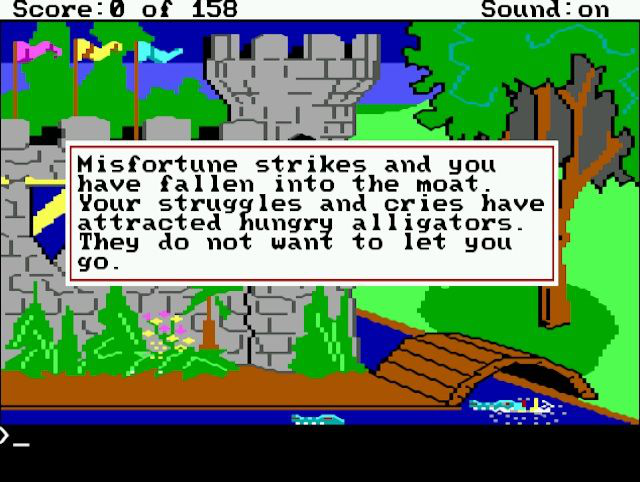 u have to find 3 treasures hidden while playing the game as a knight, Sir Graham, and to eliminate a witch as the dying king requested. If we succeed, the throne will be ours in the end.
The success was huge, the game was highly popular and 7 sequels were also completed, the last in 1998. In these, we can mess around with other witches, wizards, and mages and occupy the throne of all kinds of fabulous kingdoms.
Others followed the first two groundbreaking games. As technology advanced, manufacturers have faced players with increasingly complex challenges. All this in an environment where both the graphics and the story became increasingly sophisticated. The development of classic exit games, on the other hand, has separated itself from the forefront of computer games and has retained its minimal character to this day. In addition, live escape games brought something new in that they stepped out of virtual space.
Several escape rooms claim their historical first place and it is difficult to do justice. Most likely, the first live escape games opened at almost the same time, but without knowing anything about each other.
The first  know rooms was established more than 10 years ago: in 2006, an escape room opened in Silicon Valley and in 2007 in Japan. The playgrounds are on two different shores of the Pacific, so it is not very likely that they knew each other’s concepts. The inspiration was also different: the Japanese escape room drew inspiration from computer escape games; and San Francisco went back to the novels of Agatha Christie.
Agatha Christie, the uncrowned queen of thriller, has written nearly a hundred books in her lifetime. His first novel, The Mysterious Styles Case, was published in 1920. In this, she introduced her legendary hero Hercule Poirot, who later in around 30 books chased the mysterious killers.

Poirot and the writer’s other heroes used only their wits and logic to expose the killer. Exactly the same concept is followed by live escape games. The task is not to crush your opponent, but to find the hidden little clues and the connections between them.
Although live escape games first appeared in other countries, they spread from Budapest worldwide. In 2011, the first Hungarian escape room, started operating. Budapest has since been considered the capital of escape rooms.

Young tourists are moving towards lighter entertainment options. Sightseeing today is no longer about taking pictures of architectural sights or taking a walk around the castle. They are much more looking for ruin pubs and escape rooms, which have thus become specialty tourist attractions in Hungary.
Prize-winning Hungarian scientist, Mihány Csíkszentmihányi, developed the flow theory, which also serves as the scientific background for the escape games. When Csíkszentmihályi was looking for the secret of happiness, he found that people feel best when they can immerse themselves with full devotion in what they feel is their best.
.jpg)
The flow experience means this state. This is when time and the outside world seize to exist. Practically the experience can be triggered by any activity.
Escape games offer a great opportunity to enjoy the flow experience because they have everything in place for players to focus solely on the very specific task ahead. The escape rooms create an atmosphere that helps players, to exclude all other thoughts and to fully enjoy themselves in what they are doing.
The history of escape games began on the computer and has recently reverted to it thanks to VR (virtual reality) and AR (augmented reality) technologies.
By virtual reality, we mean an environment created with digital technology that the user can freely explore and manipulate. Anything is possible here: you can float, fly, and shoot with a laser. In addition, all this in such a way that we are surrounded by a realistic 3D environment.
Many expect a great deal from virtual reality in the future: some see the future of not only the escape games, but also the entire humanity in this new technology.
Augmented reality is a virtual augmentation of reality when, say, looking at a camera with a smartphone, projecting virtual elements into the real environment.
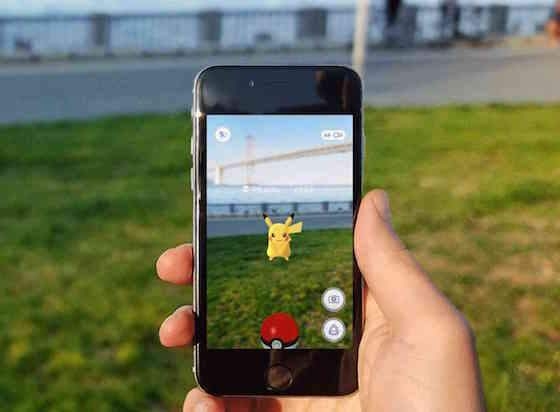
To make the definition a little clearer, enough to say that Pokemon Go also used this technology. There have been similar attempts to adapt escape games. They worked similarly, requiring only slightly more brain work on the part of the players than that of pocketing monsters.
During the quarantine time of COVID-19 pandemic the escape rooms were in need of a new approach to survive. This is Remote Escape Room. The core concept is quite simple. The only person in the physical escape room is the Game Master equipped with a video camera, the layers join to his stream online. Both the players and the Game Master can see each other, and the players task is to control the game master tell him what to look for or what to do. The puzzles are available on screen, the players have to solve them and guide the game master trough the freedom.
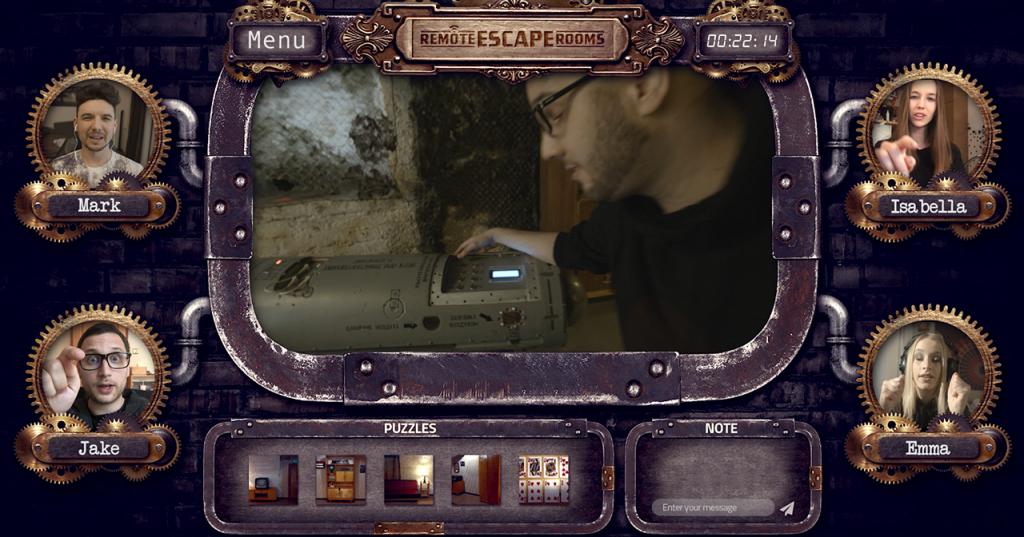
The great thing about the remote escape rooms, is that you can play it from anywhere in the world, which make it easy to play foreign Escape Rooms or plays with friends who located at a different part of the world.


